
Brand Naming
Product Naming vs. Company Naming: Which One Should You Build?
A company name and a product name can play very different roles. Customers may remember the product and never think about the company behind it, while some company names become powerful trust signals of their own. Here's how to think about both.
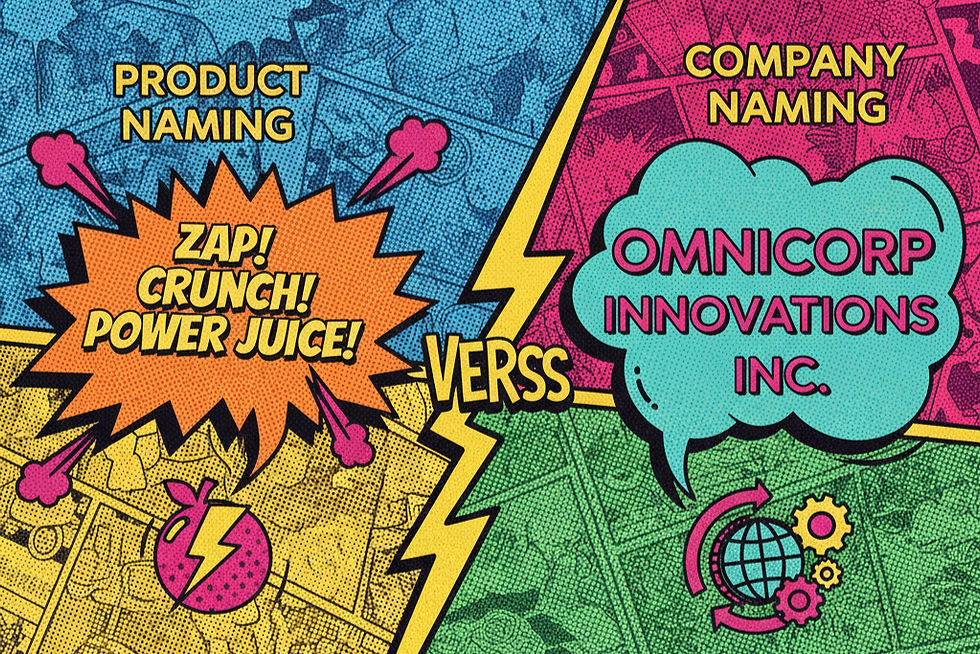
Think about how you choose a product you have bought before.
You may remember whether it worked well.
You may remember whether it was easy to use.
You may remember what somebody told you about it.
But very often, before any of that, you remember the name.
Or the packaging.
Or the two together.
That is an important distinction when we talk about naming.
Because the name of the company behind a product and the name of the product itself may have completely different roles in the customer's mind.
Product Naming vs Company Naming
A company name identifies the business.
A product name identifies what the business is selling.
That's the simple explanation.
The practical reality is a little more interesting.
Take something you bought six months ago and really liked. If you wanted to buy it again, what would you search for?
Most people would search for the product or brand name.
Very few would first try to remember the legal company behind it.
That's because the product is usually much closer to the actual buying experience.
You see it.
You pick it up.
You use it.
You recommend it.
And, hopefully, you remember it.
The company may be doing all the work behind the scenes, but the customer often builds the relationship with the product-facing brand.
Why Product Recall Matters
We talk about quality a lot when discussing why people buy products.
And we should.
Usability matters. Practicality matters. Experience matters. If a product doesn't deliver, no amount of clever branding can save it for long.
But those things come into play after the product gets into consideration.
Before a customer can choose it again, they have to remember which product it was.
Think about the products you routinely repurchase.
You probably don't remember every detail.
You remember the name.
Or the pack.
Sometimes just seeing the package is enough.
That is why a memorable product name can be far more valuable than it first appears.
It becomes a shortcut in the customer's memory.
A Memorable Name Doesn't Have to Be Short
This is one of the assumptions we come across quite often.
People ask for a short name because they believe short automatically means memorable.
It doesn't.
There are plenty of short names that sound like they could belong to any business in the category.
And there are names that are a little longer, slightly unusual or completely invented that people remember precisely because they are different.
For us, the useful question is whether the name gives the customer something to remember.
Does it sound different from the competition?
Does it fit the category?
Does it suit the people you're trying to reach?
Can someone say it naturally?
Does it look right when it appears on the product?
A name can be easy and still disappear.
A memorable name needs some distinction.
The Category Changes What a Good Name Looks Like
A product name has to live in a market.
That means you can't evaluate it by looking at the word alone.
Put it beside competing products and the picture changes.
A name might sound premium until you see that every competitor is using the same kind of language.
A name might feel modern until you realise half the category has adopted the same naming style.
This is why naming research starts with understanding the category.
What are customers already seeing?
What names keep appearing?
What language feels overused?
Where is there room to sound different?
You don't need to be unusual simply for the sake of being unusual.
You do need to be recognisable.
And the Audience Matters Even More
The same name can feel completely different to two audiences.
A D2C skincare brand is speaking to a very different customer from an industrial B2B company.
Age matters.
Income can matter.
Purchasing power can matter.
The way people discover the product matters too.
A younger customer may respond well to a playful name.
A high-value B2B buyer may expect something more restrained.
Neither reaction is universally right.
The name has to belong to the audience.
That's one reason we don't believe there is such a thing as a universally “good sounding” brand name.
There is a good name for a particular business and its particular customer.
Packaging Becomes Part of the Name
This is where product naming becomes very different from naming a company.
A company name may spend a lot of time inside emails, documents and formal communication.
A product name might be sitting on a shelf next to twenty competitors.
It has to work quickly.
The customer may see it for only a few seconds.
The name becomes part of the package.
The package becomes part of the memory.
That's why we like to think about the visual side of a product name before it is finalised.
How does it look?
How much space does it take?
Does it feel natural when printed?
Does it still work when the product is small?
Would you be comfortable seeing the name on the product five years from now?
These are practical questions, but they can make a surprising difference.
Company Names Have a Different Relationship With Customers
Now move away from the shelf.
Think about the name of the company that owns the product.
Customers may see it on an invoice.
They may see it in the fine print.
They may see it in a corporate announcement.
But they may never develop a relationship with it.
This is quite normal.
In many businesses, the customer-facing brand does the remembering while the company name sits behind it.
And that's not a problem.
It's simply one way of structuring a business.
Honasa Is a Good Example
Honasa Consumer is a useful example because the parent company and the consumer brands have very different levels of visibility.
Mamaearth is the name a customer sees on the product.
The Derma Co. is the name another customer may actively search for.
BBlunt is its own recognisable brand.
The parent company is behind these brands, but the everyday consumer relationship is built largely through the individual brand names.
The company doesn't need every customer to think about Honasa before buying one of its products.
Its business model can work perfectly well with those individual brands carrying the consumer relationship.
Tata Shows What Can Happen at the Other End
Now consider Tata.
The situation is very different.
Tanishq.
Titan.
Voltas.
Tata Motors.
Taj.
These names are different, but the Tata name itself has accumulated enormous recognition.
For many people, Tata isn't just the name of the company somewhere in the background.
It carries meaning.
It can create an expectation before someone knows much about a particular offering.
That's a very different kind of brand value.
The company name itself has become part of the customer decision.
Neither Model Is the Point
This is where the conversation gets more interesting than a simple “product name versus company name” comparison.
The question isn't really which one should win.
You can build a business where the product or consumer brand is the main thing people remember.
You can build a business where the company name carries a lot of the trust.
You can also build both.
What matters is knowing which relationship you are trying to create.
If you expect the company to launch very different products for different audiences, separate product brands may make sense.
If you want the company itself to be the common thread across everything, the parent name may need to stay much more visible.
A Company Name Can Start Quietly and Become Important Later
This is something new businesses sometimes underestimate.
When a company is newly formed, its name doesn't really mean anything to the market.
The founders may have spent days choosing it.
The customers don't know that.
They haven't built any association with the name yet.
That comes later.
The company delivers.
People experience the products.
More products are launched.
The name keeps appearing.
Eventually, customers begin attaching something to it.
Reliability.
Quality.
Consistency.
Trust.
That is when a company name starts becoming a real asset.
The name itself didn't create that reputation.
The business did.
The name simply became the place where that reputation accumulated.
That's Also How Product Names Grow
The same thing happens with a product.
At launch, the name is just a name.
After a while, the customer may associate it with something very specific.
A good experience.
A particular quality.
A particular taste.
A particular look.
A reason to buy it again.
Now the name means more than the word itself.
That is what brand building really is.
Should Your Company and Product Have the Same Name?
There are plenty of situations where this works well.
You have one main product.
The company exists largely around that offering.
The customer relationship is built around the same identity.
Keeping the name together makes everything straightforward.
You don't have to teach the customer two names.
You don't have to build recognition separately.
Every mention strengthens the same identity.
There is nothing wrong with that.
In fact, for some businesses, it is exactly what should happen.
When Does a Product Deserve Its Own Name?
The answer usually becomes clearer when the product develops some independence.
Perhaps it has its own packaging.
Its own audience.
Its own advertising.
Its own positioning.
Perhaps customers talk about it as a thing in itself.
Perhaps you expect several products under the same company and need a way to distinguish them.
That's when a product name can become much more useful.
You are giving the customer a handle for something they actually need to remember.
But Don't Give Everything a Brand Name
This is one area where restraint matters.
A business can easily start naming everything.
Every product gets a name.
Every feature gets a name.
Every version gets a name.
Every small variation gets a name.
Eventually, the marketing team has a whole vocabulary that customers never asked for.
A product name should earn its place.
If a feature can simply be described clearly, maybe it should stay a feature.
If three versions of a product don't need separate identities, maybe they don't need three new names.
More names do not automatically create more brand value.
Sometimes they just create more things to remember.
The Second Product Is Where the Naming Strategy Gets Tested
Your first product can hide a lot of problems.
There is nothing to compare it with.
The second product changes that.
Now you have to decide whether it should use the company name, have its own identity, or follow some kind of naming relationship with the first.
Then comes product three.
Then four.
At that point, naming becomes a portfolio question.
Current naming specialists increasingly describe this as a brand-architecture issue: the names need to have some logic as the portfolio grows, otherwise every new launch creates another naming debate.
You don't need a complicated corporate naming system.
You do need to know what you're building.
Think About the Names Together
There's a very simple exercise you can do.
Take the company name.
Put the first product beside it.
Then add two imaginary future products.
Don't spend hours naming the future products.
Just use placeholders.
Now look at the group.
Does it make sense?
Does it feel like one company?
Would a customer understand the relationship?
Is one product suddenly trying to behave like a completely different brand?
This exercise is useful because it forces you to look beyond today's launch.
There Is Also a Difference Between a Company Name and a Customer-Facing Brand
For many businesses, especially in India, the legal company name and the name used publicly can be different.
That's perfectly possible.
The company may have its formal registered name, while the customer interacts with a separate brand.
So when someone says:
“We need a company name.”
it's worth asking what they actually need.
Are they naming the legal entity?
The public-facing brand?
The first product?
A future product portfolio?
Those questions can lead to very different naming directions.
What We Think About at 99Logos
When we work on naming, we don't start with the assumption that a company name and a product name have to behave the same way.
We look at the business first.
If it is a product, who will buy it?
How will they discover it?
What does the category already look like?
What kind of recall does the name need?
Will it look good on packaging?
Will the audience understand it?
Can it grow with the product?
For a company name, the questions are broader.
What is the business trying to become?
Could there be several products?
Could the business expand into another category?
Do you want customers to know the individual brands, the parent company, or both?
Those conversations matter much more than simply asking for a list of names.
We Also Don't Think the Longest List Is the Best List
This is something worth mentioning because it comes up often.
People sometimes judge naming work by the number of options they receive.
Twenty names.
Fifty names.
One hundred names.
But the difficult part isn't producing names.
The difficult part is removing the wrong ones.
A name may be clever but too close to a competitor.
Another may be memorable but completely wrong for the audience.
One may look good on paper but fail when put on packaging.
Another may be perfect for the product but completely unsuitable for the company behind it.
Good naming gets more selective as it moves forward.
The shortlist should become smaller.
The thinking should become stronger.
So Which Name Should You Build?
Start by deciding where the customer relationship is going to live.
If the product is going to be the thing people recognise, remember and ask for, invest heavily in the product name.
If the company itself is going to be the common source of trust across different products, give the company name equal attention.
And if you want both to matter, build the relationship between them carefully.
There is no reason one has to destroy the value of the other.
Final Thoughts
A product name can be the thing that brings a customer back to the shelf.
A company name can eventually be the thing that makes them comfortable trying something new.
One can build recall.
The other can build reputation.
Sometimes the product becomes the stronger brand.
Sometimes the company becomes the stronger brand.
Sometimes both grow together.
That is why I don't think the most useful question is:
“Should we focus on the company name or the product name?”
I'd ask:
“What do we want people to remember, and what do we want them to trust?”
Once you know that, the naming decision becomes much clearer.
And there's one more thing worth remembering.
You don't create a legacy simply by finding a brilliant name.
You create it by doing enough good work under that name that people eventually attach something valuable to it.
The name gives them something to remember.
The business gives them a reason to remember it.
That's true for a product.
And, over time, it can become true for the company behind it too.
Frequently Asked Questions
What is the difference between product naming and company naming?
A company name identifies the business, while a product name identifies a specific offering. The two can be identical, closely connected or completely separate depending on how the business wants its customers to experience the brand.
Which is more important, a product name or a company name?
Neither is automatically more important. A product name can become the main source of customer recall, while a company name can become a broader trust signal as the business builds a reputation.
Should my company and product have the same name?
They can. A shared name can make sense when the business has one main offering and customers naturally associate the company and product together.
Does every product need its own name?
No. A product deserves its own name when independent recognition provides a real benefit. Features, minor variations and supporting offerings may be better handled with clear descriptions.
Does a memorable product name have to be short?
No. Short names can be practical, but memorability depends on more than length. Distinctiveness, sound, association, audience fit and context can all influence recall.
Should a product name be different from competitors?
It should have enough distinction to be recognised within its category. A name doesn't need to be unusual simply for attention, but it shouldn't disappear among similar competitor names.
Does packaging matter when choosing a product name?
Yes. Product names often live directly on packaging, labels and other physical or digital touchpoints. A name that works well verbally should also be considered in its eventual visual context.
Does the target audience matter when naming a product?
Yes. Factors such as age, income, purchasing behaviour, industry and whether the product is B2B, B2C or D2C can affect how a name is received.
Can a company name become a brand?
Yes. A company name can accumulate recognition and trust through years of business activity and eventually become a valuable consumer-facing asset.
Can one company own several product brands?
Yes. A company can build a portfolio of separate brands or products while remaining the parent organisation behind them. Honasa is an example of this kind of structure.
What is brand architecture?
Brand architecture is the way a company's company name, brands and products relate to each other. It becomes particularly relevant once a business has multiple products or expects its portfolio to grow.
Should every software feature have its own name?
No. A feature should generally receive its own name when there is a genuine reason for customers to recognise, discuss or distinguish it independently. Otherwise, a clear description may be more useful.
Can the legal company name be different from the brand name?
Yes. A legal entity can operate a separate customer-facing brand. The exact registration, trademark and naming requirements depend on the business and jurisdiction.
When should I consider professional naming help?
It can be useful when naming a new company, launching an important product, building a product portfolio or deciding how company and product names should relate. The value is in the research, naming direction, filtering and practical evaluation — not simply producing a large list of words.
You may also like

Trademark Screening vs Trademark Registration: What's the Difference?

Why Do Some Brand Names Fail? Common Naming Mistakes Businesses Make

How Important Is Domain Availability When Choosing a Brand Name?
Naming . Identity . Logo . Packaging . Positioning